Scottish Whisky

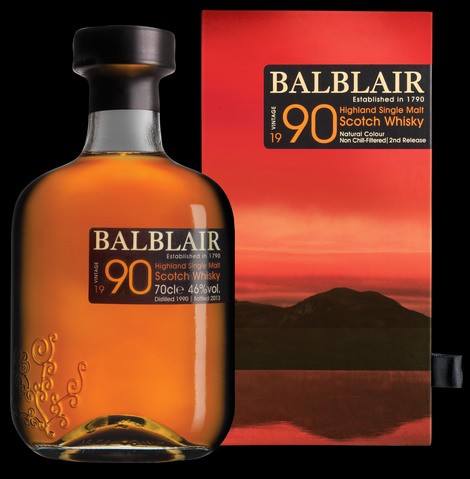
Balblair 1990

Balblair Highland Single Malt Scotch Whiskey 1990 Vintage
46% ABV
$125
Website
1990_Black_background_whisky_detail
What the Distillery Says:
Matured in American oak ex-bourbon casks and Spanish oak ex-sherry butts Balblair Vintage 1990 2nd release is truly exceptional. Recently released to replace our award-winning 1989 Vintage, this incredible dram is sure to become a firm favourite amongst Balblair fans and whisky connoisseurs.

Tasting Notes

Appearance: The second release of Balblair 1990 is deep copper in appearance with hints of sparkling amber.
Aroma: The aroma is spicy yet sweet and is punctuated with notes of raisins, toffee and honey. Hints of vanilla, chocolate and citrus fruits are also present.
Palate: On the palate it is full bodied; sweet and spicy in character with hints of honey, raisins and zesty fruits.
Finish: The finish is smooth and long-lasting.

What Richard Says:
Nose: The sherry jumps forward on the nose with spice accented sweetness. I’m thinking a treacle tart with a sherry reduction drizzled on top.
Palate: This is a slower build than the 1999 but it’s well worth the wait. It comes in muted but then swells with notes of creamed honey, buttered cinnamon raisin toast, citrus zest, and stewed fruit with a back note like biting into a black peppercorn.
Finish: Damn these older Balblairs have a finish that last for days. Cinnamon, ginger, and cocoa powder interplay well with the wood on the finish.
Comments: To be honest for a long time I had intentionally overlooked Balblair. My earliest encounters were under whelming. The newer young-ish iterations show a fruity brightness that is very easy to enjoy. These older Balbairs are spending a year or so in sherry casks as a finish and the marriage works out tremendously well. The 1999 was a joy to drink and this 1990 is like it’s older more subtle and refined brother. Very delicious and at it’s price point for a 21+ year old single malt this one is a must buy.
Rating: Must Buy

We would like to thank Lukasz with Alembic Communications for sending over the review sample.

Balblair 1990 Read More »

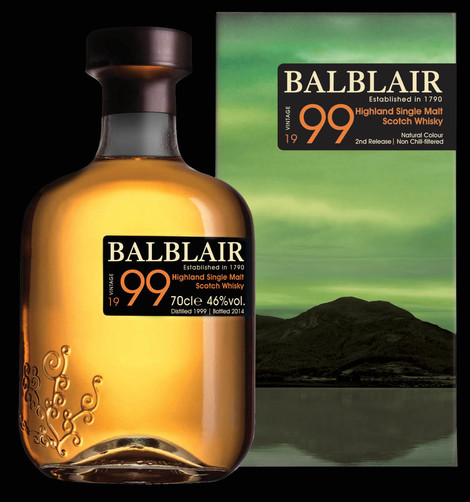
Balblair 1999

Balblair Highland Single Malt Scotch Whiskey 1999 Vintage
46% ABV
$80
Website
Balblair_1999_mock-A-domestick_whisky_detail
What the Distillery Says:
ummer 2014 sees the launch of the second release of the 1999 Vintage from Balblair Single Malt Scotch Whisky. Set to hit shelves at the end of June, Balblair Vintage 1999 will be available globally in Independent and Specialist Retailers.

Balblair 1999 replaces the award winning second release of the 1997 Vintage; the introduction of the 1997 Vintage took the core collection from three to four expressions. The 1999 Vintage will be presented in a premium opening box, joining the complete Balblair collection available in this luxury format.

Tasting Notes

Appearance: Balblair 1999 2nd release is copper in appearance with flecks of sparkling bronze.
Aroma: The American oak, ex-bourbon barrels and Spanish oak, ex-sherry butts used for maturation impart the signature Balblair aromas of honey and green apples, as well as notes of rich, fruity Christmas cake with a hint of spice, citrus fruits and vanilla.
Palate: On the palate it is full bodied, sweet and spicy in character, with hints of honey, vanilla and leather.
Finish: The finish is warm, smooth and long-lasting.

What Richard Says:
Nose: Fruit cake drizzled with a sherry reduction. It’s smells much better than fruit cake tastes. Under ripe apples, leather and lemon zest.
Palate: Rich, spicy, sherry, and honey sweet with layers of leather and tobacco. This is delicious and drinks much older than it’s years.
Finish: Woody, dry, and tannic on the finish. It lingers damn near forever.
Comments: This is a very nice whisky. Unlike so many others the palate delivers what the nose promises. The years spent finishing in a sherry cask have done wonders for the underlying Balblair malt. The finish is a bit tart, chalky, and tannic which I’m not crazy about but just keep drinking it and this isn’t a problem.
Rating: Must Try

We would like to thank Lukasz with Alembic Communications for sending over the review sample.

Balblair 1999 Read More »

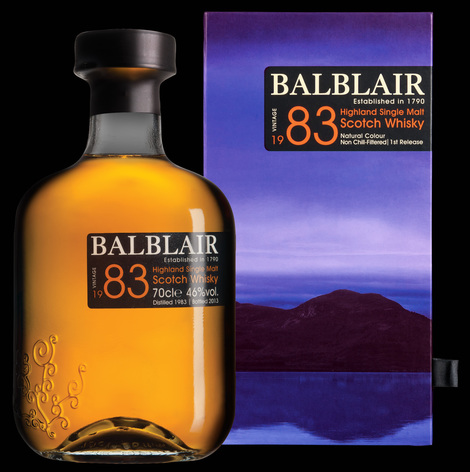
Balblair 2003

Balblair Highland Single Malt Scotch Whiskey 2003
46% ABV
$65
Website
2003_Black_background_whisky_detail
What the Distillery Says:
Launched alongside 1990 & 1983 in November 2013, Balblair Vintage 2003 replaces Vintage 2002. The American oak, ex-bourbon barrels used in maturation impart toffee, butterscotch and vanilla notes.

Tasting Notes

Appearance: Balblair 2003 is golden amber in appearance.
Aroma: On the nose there are the signature Balblair aromas: floral and fragrant punctuated with citrus fruits, apricots and honey.
Palate: On the palate it is full bodied, with notes of oranges, lemon, honey and spice.
Finish: The long lasting finish is sweet yet spicy; a superbly well-balanced dram.

What Richard Says:
Nose: Floral,fruity, slightly herbal with hints of vanilla. Citrus zest with a little back nuttiness.
Palate: A lovely light honey sweetness. As light as it is the higher proof gives it more of a viscous creamy mouthfeel that is very nice with the honey and just a bit of pepper on the back end. Poached pears and cereal grain compote.
Finish: A little bland and a wood not that reminds me of toothpicks dusted in ground white pepper.
Comments: This is a nice approachable and easy to drink dram. It’s not terribly complex but it is terribly drinkable. I like it much better than the 2002 it replaced. The pricing is steep though.
Rating: Stands Out

We would like to thank Lukasz with Alembic Communications for sending over the review sample.

Balblair 2003 Read More »

Cascade of Variables

I was perusing another blog recently and a saw a question about the rerelease of Old Grand Dad bourbon in all new packaging. The post went on to talk about the history of the brand. One of the commenters asked about why there is so much difference between the Old Grand Dad made by National Distillers back in the day and the one now made by Suntory Beam. That got me thinking about all the variables that go into how a particular whiskey tastes. I’ve seen focus pieces in magazines and books around certain aspects (wood management, etc.) of flavor drivers but nothing more comprehensive. Frequently, you will hear someone in the industry say that X% of the flavor comes from the wood. Whatever that percentage is I’m not going to argue with it. However, the remainder is made up of many more factors than you might think. So let’s talk about that for a few minutes.

Mashbill: The first thing that comes to mind when thinking about how a particular whiskey gets its flavor is the mashbill, or the blend of grains that make up the mash used to make the distiller’s beer. The most basic example of this is bourbon versus scotch. Single malt scotch is a barley base while bourbon is corn first with lesser components of rye, wheat, and barley. When you taste a lot of younger bourbons especially, that corn forward flavor really shines through.

Grain Varieties: After the blend of different types of grains is established the next stop in the cascade of flavor would be the varieties of each grain used. The single malt scotch industry is a great example of this. It’s all barley but the varietals vary from distillery to distillery. Some use Optic, others use Golden Promise, yet others use a mix of numerous varietals. The various varieties were first developed for increased yield and environmental resistance but there are flavor nuances too.

Malting & Peat: If you’re working with barley, whether or not you malt that barley has a distinctive impact on the flavor. If you malt all of it (single malt scotch), some of it (Irish whiskey), or none of it (some American whiskeys) then the end result can be drastically different. Taking it a step further, how you malt the barley can be one of the most impactful components of flavor? Peat smoke anyone?

Water: After getting all our grains sorted we move to the next component…water. Water is water, right? No, it isn’t. Given the environment and location, the water source can affect the flavor. Is it filtered through peat bogs or limestone? Traces of those can be found in the water. When you also take into account that a lot of distillers cut their whiskey for bottling with the same water used in distillation then as much as 60% of what’s in the bottle is that water. Do you know why Four Roses uses five distinct yeast strains? According to Master Distiller Jim Rutledge it came about as Seagrams consolidated their bourbon operations to the one facility. They didn’t want to lose the array of flavors they had so they found yeast strains in their yeast banks that mirrored the flavors from the water sources at the closed facilities.

Yeast: That was one of my better segues into yeast. So you put the grains and the water in the fermentation tanks but you need that yeast to get the whole sugar to alcohol conversion going. The yeast you use can have a significant impact on the finished product. Just look to Four Roses again. Try the five different bourbons they produce using each mashbill but with different yeasts and you begin to see a distinct difference.

Fermentation Time: How long do you let the mash ferment? There is no one right answer. Longer you get more sugar conversion and more dead yeast. Does that impact the flavor? Probably. Is it noticeable to the consumer? I have no idea.

Fermentation Vessel: Pine washback or stainless steel fermentation tank? Last year I visited a local fellow who is using large plastic tubs. Again, the method used could well be impacting the flavor of the finished product.

Still Type: Coffey, Column, Continuous, or Pot Still. What’s your weapon of choice? All impart different flavor profiles on their spirits. Woodford is a great example. Did you ever notice that no matter what whiskey they make at Woodford there is a uniquely Woodford note to the nose? Why is it so different from other bourbons or even the other Brown-Forman bourbons? Even the recently released Woodford Rye has it on the nose. I’m betting it’s that pot still they use.

Still Design: This takes the previous variable and pushes it down to a more minute level. It’s easier to see in the scotch industry. Among single malt distillers they will often talk about the shape, volume, and height of their stills in discussing the aspects of flavor. It factors in copper contact and how much reflux passes through versus rolling back into the still.

Distillation Proof: The proof or alcohol strength that the spirits comes off the still at will also impact the flavor. I’ll lump this in with barreling proof for sake of not splitting too may hairs (too late?). A great example of this is Booker’s. Beam uses the same wood, same mash, same so location, same still, etc., etc. with Knob Creek, Baker’s and Booker’s. However, Booker’s comes off at 125 proof versus 135 for everything else. They do it so they don’t have to cut it before going into the barrel but it does give Booker’s a distinctive profile.

Number of Distillations: Once, twice, three times a whiskey. Basically, the more times you distill a particular spirit the less of the impurities there are that pass into the final product. Scotch is usually distilled twice and Irish whiskey is usually distilled three times as basic examples.

Cuts: During distillation a choice is made on the front and back end of the distillation run. That choice cuts off the first part (heads) and the last part (tails) to be redistilled or disposed of. In those first and last parts are chemical compounds (congeners, etc.) that are seen as impurities but also flavor components. Depending on how much you cut off rather than let pass through to the next stage will impact your flavor.

Wood Type: New oak, refill hogshead, sherry cask, European Oak, American Oak, etc. All these are examples of the references you will hear about whiskeys. It is probably the most talked about factor affecting flavor, especially in scotch. A “sherried scotch” anyone? That’s the big thing that the cool kids are drinking now right? The wood type and what, if anything, that previously resided in the that wood will give distinctive flavors to the finished product.

Barrel Size: Now that you’ve determined your desired wood you have to figure out how big of a barrel you want. Smaller barrels give you more wood to whiskey contact but can leave the whiskey overly woody in flavor. It’s a delicate balance.

Warehousing: Stone walls or wood? Single story or four story rickhouses? The size, shape, design, and location of the warehouse can impact the maturation environment and further impact the flavor.

Barrel Location: Taking the warehouse location one step farther, within a given warehouse where the barrels are can also impact it. Some distilleries do barrel rotations throughout the life of their barrels to drive consistency. Others realize that certain parts of the warehouse are better for certain flavors and as a result certain brands come from those areas. Buffalo Trace produces a large number of brands from just two ryed bourbon mashbills. Some of those are picked only from certain locations within the warehouses. They recently released experimental releases from three distinct warehouse locations to emphasize this point.

Climate: The climate also affects the maturation which in turn affects the flavors. In Kentucky for example there are much more extreme fluctuations in temperature through the course of a year than in Scotland. That causes the whiskey to push deeper into the wood and extract farther back out with a regularity that pulls flavor compounds out of the wood more effectively.

Age: This one is kind of a no brainer but I added it for completeness.

That’s 18 variables on my list. I realize that this is not an exhaustive list. It’s a list of variables that most come to mind for me when thinking about flavor factors in whiskey. If you feel there are critical ones that I’ve missed then by all means post and we can continue the dialogue. Regardless of how many are on your list I hope the point is made that there’s more to the flavor of a whiskey than wood and water.

Cascade of Variables Read More »

SMWS Cask 93.61

SMWS Cask No. 93.61
Campbeltown
58.3% ABV
$?
Date Distilled: June 1999
US Allocation:
January 2015 Outturn Release

What the SMWS Says:
On the nose, the sweet charabanc of sugar puffs, Crunchy-nut cornflakes, fudge cookies, honey and chocolate flapjacks collided into the savoury wall of smoky bacon crisps, barbecued prawns and baked ham. The palate was also a crash site – big, rich and chew, with cinder toffee, spiced sultanas and dark honey on toast scattered in a frightening wreckage of charcoal, ash, liquorice sticks, peat reek and industrial garages. The reduced nose suggested a welder on a Calmac ferry enjoying a Daim Bar. The palate – sweet and (we thought) acceptably dirty with a big spicy finish. From the ‘quiet outsider’ distiller in Campbeltown.

Drinking tip: To aid the visceral enjoyment of a brutal rugby match.

What Richard Says:
Nose: Wow what an interesting dichotomy playing out here. The smoky and savory are close dance partners with the sweeter confectionery notes all while sherry cream plays the chaperone.
Palate: Damn that’s good. The alcohol is there but it is so rich and viscous you hate to add water. That confectionery sweetness from the nose carries into the front of the palate with a rich honey that fades into more of the campfire notes.
Finish: The proof gives it a little heat but after that clears the throat it leaves you with a pleasant sooty woody finish.
Comments: This is a great dram but it drinks at a much higher proof than your typical single malt. Add the water but do it drop by drop until you get it just right. A couple of drops too much and you’ve killed it. It turns bland, uninspired, and the richness is gone.
Rating: Must Try

SMWS Cask 93.61 Read More »