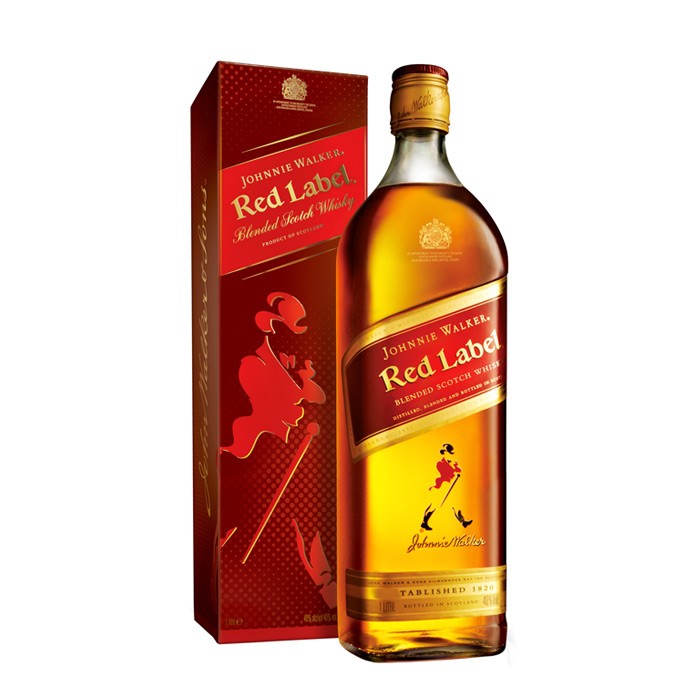
Johnnie Walker Red Label Old Scotch Whisky (Blended)
40% ABV, 80 Proof
$20-25, Available Everywhere
What The Distillery (Blender) Says:
Johnnie Walker Red Label is a rich, full-bodied blend of up to 35 of the finest aged single malt and grain whiskies. Bursting with character and flavor, it’s the favorite of millions of people all over the world.
Its vibrancy makes it perfect for mixing – something few other spirits can do without losing their true character.
Red Label was first unveiled in 1906 by Alexander Walker as a powerful combination of spicy, smoky malts and lingering, lighter grains. He called it “Special Old Highland Whisky.” In 1909, Alexander renamed it “Johnnie Walker Red Label” in deference to his consumers who were already using “Red Label” as shorthand when ordering the brand.
What Richard Says: Nose: Apples and caramel. Kind of like the candied apples you get at the county fair but not quite. With water the nose opens up a slightly woodier character. Palate: Wow, this stuff is really boring. It’s nearly flavorless. There are hints of tobacco and wood but they are the faintest hints and then they’re gone. JW Red doesn’t really taste bad, it just doesn’t have much of a taste at all. Finish: Relatively smooth (I would hope so with a palate that dull). There is a little burn on the sides of the tongue and it leaves the mouth tasting medicinal. Comments: Scotch for the young’uns who just want to get drunk. A mixer to add alcohol content to something else. Not really worth your time. Rating: Probably Pass
What Matt Says: Nose: Smoke, leather, nail polish remover, caramel and vanilla. Turns sour with water (smells like hangover vomit). Palate: Less burn than Dewar’s White Label, but there is not much here. Smokey (charred oak as opposed to the tobacco in Dewar’s) and a little sour. With water, the texture firms up and some burnt toffee notes open up. Finish: Nothing on the center of the tongue, but the burn lingers around the edges along with the sourness. Water brings out the toffee notes in the finish as well. Comments: I enjoy much of Johnnie Walker’s line, but something about the Red Label turns my stomach. Dewar’s White Label is nothing special, but there is nothing stomach churning about it either. If it’s a choice between this and Dewar’s, go with the Dewar’s every time. If this is the only whisky in the house, drink beer or volunteer to be the designated driver. Rating: Probably Pass
I am a firm believer in giving and receiving whisk(e)y as a gift for a momentous occasion. On birthdays, it’s nice to have a dram that shares your age (although, at 30 already, I know that is not going to be happening a lot anymore). In my circle of friends, Johnnie Walker Blue seems to be the dram of choice for weddings and law school graduations (thanks to Diageo’s relentless advertising no doubt). Gifts don’t have to be overly expensive, but rare and/or unique are a plus. For something rare, unique, and undoubtedly expensive, Ian Macleod Distillers and Glengoyne have come out with two new drams for your special occassion. Here’s the sitch:
Independent bottlers and distillers, Ian Macleod Distillers, is to launch an extremely rare, limited edition Springbank 40 Years Old from its award-winning Chieftain’s Single Malt Whisky collection.
And, for the first time in its 175 year history, the award-winning Glengoyne Distillery is to release its oldest, most valuable, and very best, Highland Single Malt: the Glengoyne 40 Years Old. (from a press release provided by Whisky Magazine)
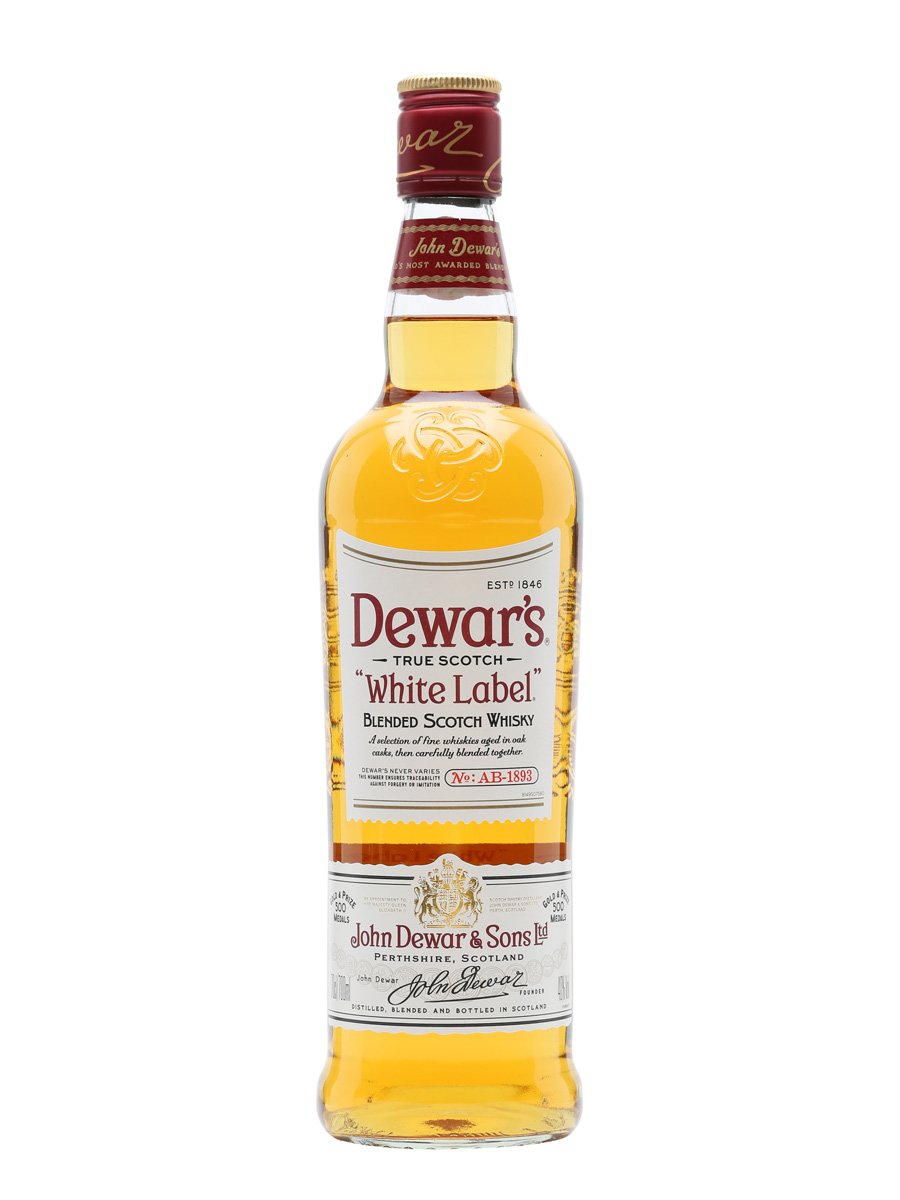
Dewar’s White Label Blended Scotch Whisky
40% ABV, 80 Proof
Around $30, Available Everywhere
What The Distillery Says:
The long-celebrated Dewar’s White Label was created by John Dewar & Sons first master blender AJ Cameron in 1899 and has been the company’s leading blend for over 100 years. Only the Dewar’s Master Blender can unlock the secrets of this closely guarded recipe, which has been passed down from Master Blender to Master Blender and continues to produce a smooth, perfectly balanced taste that never varies.
A blend of up to 40 single malt and grain Scotch whiskies, White Label’s distinctive heather and honey notes evoke the rich heritage of the Scottish Highlands, thanks to the fine Aberfeldy single malt at its heart.
What Richard Says: Nose: Citrus (navel oranges?) and wood chips. Water opens up the wood, hides the citrus, and adds a medicinal tinge. Palate: I know this is going to sound cliche but Dewar’s tastes like Scotch. By that, I mean it tastes like the stereotypical Scotch. You get oak notes, peppery spice, a hint of iodine, and that’s about it. It’s delicate on the front and back of the palate but it zings you with pepper in the middle. Nothing too special about the flavor profile. Finish: Very smooth. The Dewar’s leaves peppered oak behind and not much else. Comments: Dewar’s White Label isn’t bad, it’s just not special in any way. I’ve tasted a lot of the newer things that Dewar’s has been developing recently and they are all pretty good. The Signature is exceptional (review to come). However, their standard expression isn’t much to write home about. It’s like the Budweiser of Scotch. I would probably put it down in cocktails, over ice, or with soda.
Rating: Probably Pass
What Matt Says: Nose: When I first poured this dram, I got a lot of caramel and a little vanilla. However, once the whisky had a chance to settle, there was nothing but nail polish remover. Perhaps pouring this through a wine aerator would open up the nose a little more. A little water brings a bit of peat to the party, but all other notes are muted to obscurity. Palate: The dominant flavor here is tobacco; there is a subtle sweetness that brings to mind sweet cream. Again, water brings out a little peat. It also helps tone down the tobacco. Unfortunately, the sweeter notes lack the punch to shine through and hang out at the back. Some burn with this one (water helps). Finish: Long finish of cigar butts and a slight burn at the sides of the tongue. Comments: Not a bad intro into blended Scotch (partly because of its availability). I cannot recommend that you sip this though. White Label is better enjoyed on the rocks or with club soda. Dewar’s is an especially good intro into whisky for smokers and chics with daddy issues. Rating: Probably Pass
Overall Rating: Probably Pass (unless it’s the only thing around and you have some extra soda to get rid of)
Balvenie 17yo Releases in reverse chronological order.
Friday night, Sam Simmons (known as to some) hosted a class at Astor Center, titled “The Influence of Wood Finishing on Whisky: A Retrospective of The Balvenie 17yr.” Needless to say, I was excited when I first heard about this event. Since the release of Glenmorangie’s line of wood finishes, I have dreamed of either hosting or attending a class where participants were given the opportunity for side by side tastings of variously finished whiskies. In my head, this class would include tastings of the finishing barrel’s previous contents. Sam, it seems, is of a same mind. Although he used the various Balvenie 17yo releases instead of the Glenmorangie that sparked the idea in my head, I could not have been more thrilled (he is the Balvenie brand ambassador for the US after all).
Sam started the night with little history about the Balvenie and why it is his favorite distillery (family owned, they grow their own barley, they malt their own barley, employ their own coopers and copper smiths, and of course Master Distiller/Blender David Stewart). Now you may say, “but Matt, he’s the brand ambassador, doesn’t he have to say these thing?” Well, yes and no. He tells the truth on all accounts. The list above is what makes the Balvenie stand out among the myriad of distilleries sprinkled about Scotland. Furthermore, Sam asserts that his love of the Balvenie started long before he became an employee of William Grant and Sons. I think we can trust him on this.
Roughly 70% of whisky’s flavor comes from the barrel. This is why the type of barrel is so important in the initial maturation and finishing of the product. To that end, Sam started the evening with some neutral spirits straight from the still. Not straight from the still exactly, the spirits had been cut to 63% ABV as that is what goes into the barrel for aging. If you have ever had grappa or moonshine, you have an idea what this tastes like. The nose smelled faintly of fruit with heavy cereal and alcohol notes. The taste? Well, the alcohol is strong with some malty goodness buried in the back.
Next we moved onto the actual whisky. David Stewart created a firestorm in the whisky industry back in 2000/2001 with the introduction of the Balvenie Islay Cask. Industry insiders, enthusiasts, and casual drinkers were giddy with this “best of both worlds” style bottling. David being an adventurous man, he responded with, not more Islay cask, but with a New Wood release in 2005/2006. Since then, New Oak, Sherry Oak, and Rum Cask have all hit the market. Apart from the Rum Cask (released just last year), the whiskies are very difficult to find and have become collector’s items. How any man can buy a bottle of whisky and just look at it, I’ll never know. Our tasting moved in reverse chronological order.
The Balvenie 17yo Rum Cask spent four months in Jamaican rum casks after 17 years in traditional oak. This is an excellent dram, but I was hoping for something a little more akin to the Glenfiddich 21yo Rum Cask. Where the Glenfiddich is well balanced, the Balvenie is a little too sweet for my palate. It is almost cloying in its sweetness. Perhaps this is a function of age, but I think that the deeply honeyed nature of the Balvenie just goes over the edge here (slightly). We tried this along with Appleton Estates Jamaican Rum (one of my favorites). Sam could not confirm the source of the Jamaican rum casks used at the Balvenie, but we were still able to tasted the lineage of this whisky. The rum imparts the smells and flavors of bananas and coconuts to the already sweet whisky. If you’ve ever wanted to taste a whisky that smells like a banana split, here’s your chance.
For the Sherry Oak release, the whisky spent all 17 years in Oloroso sherry butts. I am not a sherry drinker. However, I tend to like whiskies produced in this manner (the Macallan, the Glenrothes). I was interested to see how the Balvenie would hold up to the sherry. I have to say, it was a let down for me. Once again, we have a balance problem. The whisky smelled delightful (like baked apples). However, the palate was overly sherried for me. The proof of the connection was provided by a glass of Oloroso sherry. After a few sips back and forth, I was sure that the sherry was holding the whisky back.
The New Oak release was quite an experiment. First David Stewart vatted 17yo whisky from sherry casks and bourbon casks. Then, he aged the vatted whisky in new toasted oak casks for four months. My favorite whiskey so far, the nose was like creme brulee with traces of mint. The palate had mint and the traditional honeyed tones morphed into agave and maple syrup. We tried this with a 12yo Elijah Craig bourbon (a good dram by itself). Once again, Sam cannot verify the source of the barrels used in the production of this whisky, but he says that he has seen Heaven Hill (the producers of Elijah Craig) barrels around the warehouse. That is why he chose this particular bourbon to supplement the tasting.
The New Wood release, featured whisky aged first in barrels that previously held Balvenie whiskey then in new oak barrels. This is a real wine drinker’s whisky (bright, citrusy, oak and honey). Tried next to a very oaky Chardonnay, this whisky stands out as unique and interesting. Not a bold whisky by any means, but a good whisky to complement food or to tempt a wine drinker from vine to grain.
Finally, we reached the Islay Cask. This whisky is long gone from store shelves and is now relegated to online auctions and collector’s cabinets. It is really a shame though. This is the best of the five releases so far, and you can see (taste) why this created such an uproar when released. We tasted this with Laphroaig 10. Laphroaig is highly peatly and not very well balanced, but it is reasonable to assume that Laphroaig or something similar slept in these casks before they held 17yo Balvenie. The alchemy of this release is really interesting. The nose is honeyed smoke, like a bonfire on the beach at dusk as the wind carries scents of honeysuckle from the shore. The palate carries on the smokey sweetness and adds butter toffee and citrus. Truly a delightful whisky.
I am grateful to Sam Simmons for offering this class. It was really a dream come true for me. Although I curse him for giving me the opportunity to fall in love with another whisky that is beyond my grasp.
After the “Blend Your Own Balvenie Signature Reserve” class, one of our readers asked if there were any plans to take that class to the UK. Well Ian, I’m afraid neither that class nor this one will be offered over there. These classes were both stocked from Sam’s personal collection. Sorry folks.
Normally, Balvenie is not a brand that inspires me to great oration. To my palate, the young Balvenies are so uninspiring that I have never made it to the end of a tasting table. Richard tells me the 20yo is quite nice and I will make an effort to try that in the future. However, what whisky geek could pass up the opportunity to blend their own single malt? I approached this event with unadulterated schoolboy glee and I was not disappointed in any way.
The class took place at Astor Center in NYC and was lead by Dr. Whisky (Sam Simmons, US brand ambassador for Balvenie) and David Mair (Balvenie’s global ambassador). When I take my seat on the front row, I am greeted by a lovely young woman who offers me some prosecco to “get [me] started.” Then, as I admire the Balvenie branded tasting diary and the various glasses, bottles, and droppers at each station, both Sam and David come over to introduce themselves. This is already looking like a good event.
Sam starts by telling us a little about Balvenie Signature 12yo Batch #1 (voted “Best Speyside” in a blind tasting for the New York Times, etc.). We taste Batch #1 (no longer available, btw). Sam then hands proceedings over to David for a little history about whisky in general and Balvenie specifically. I’m not going to get too technical, but a few things stand out about Balvenie as a distillery. First off, Balvenie is the only Speyside distillery that malts their own barley on a traditional malting floor. Not all the barley they use is from these maltings, but a good portion. The fuel for these maltings comes mostly from anthracite (smokeless coal), but they add a small amount of peat for flavor. Additionally, a portion of the barley used is grown on the premises. Throw in custom copper pot stills and you have a truly handcrafted product.
“So what does it taste like,” you ask. Patience, my friends. Sam somehow convinced the master blender (David Stewart for those taking notes) to part with a few bottles of whiskey that he uses to blend Balvenie Signature 12yo. This was a real treat, since these whiskies are not commercially available. Balvenie Signature is comprised of three 12yo single malts: one aged in bourbon casks, one aged in sherry casks, and one aged in refill whisky casks (casks that first held bourbon, then Balvenie whisky). Although from the same source whisky, each of these spirits have distinctive characteristics.
The bourbon cask produces an amber-colored whisky. I really enjoyed this. If Balvenie bottled this, it would be my whisky of choice more often than not. With a heavenly nose of malt, vanilla, and caramel and a palate that replicates the nose plus maple syrup, this is one for the books. When comparing it to the Signature, I can find where it lives in the blend. It seems to be responsible for most of the flavor profile.
The sherry cask gives the Signature most of its color. This whisky is deep and dark, almost a jewel tone. The nose is complex. Notes of black pepper, cloves, tamari, bacon, and celery fill the nose along with a touch of sweetness. The palate is very powerful and tastes of roasted hazelnuts, Christmas spices and sherry (of course). On it’s own, this one is a bit much, but it sits nicely in the back of the blend.
Finally, the refill whisky cask is very pale in color. The nose is remniscent of fresh fruit and licorice. The palate is overwhelmed with licorice. Unlike the herbal licorice of an Islay malt, the licorice of this dram is more like a classic Brach’s black jelly bean.
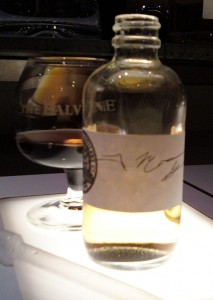
After sampling all this, we had the opportunity to blend our own Balvenie Signature. You can see mine in the photo above. This was great fun. We compared ours to Batch #1, but the intent was to come up with our perfect blend not necessarily to match David Stewart’s creation. I was feeling pretty good about mine, thinking I could be a master blender some day. Then, Sam brought out Balvenie Signature 12 yo Batch #2 (available in June for $52.99). I have to bow to the superior skills of Mr. Stewart. Mine was good, but his impeccable ability to create a multi-layered masterpiece was awe inspiring. I could taste the elements of the construction. Even the candy licorice flavor floated across the palate like a thin sheen of oil on clear water. However, Balvenie Signature is greater than the sum of it’s parts. I for one, will be standing at the door when this hits the shelves.
In conclusion, this is the best whisky event I have ever attended. I gained a greater appreciation for what blenders/distillers go through to create all this wonderful whisky. Thanks to Sam, David, and the folks at Astor Center for putting this together. I would love to see more classes like this.