Other Whisk(e)ys

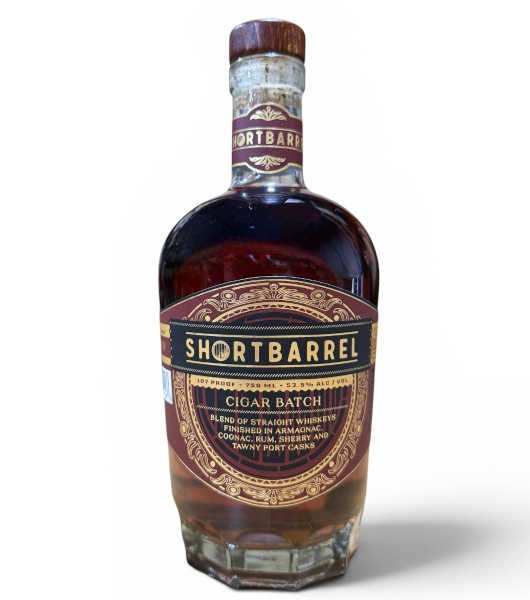
Shortbarrel Cigar Batch IV Blend of Straight Whiskeys

Shortbarrel Cigar Batch IV
Blend of Straight Whiskeys Finished in Armagnac, Cognac, Rum, Sherry & Tawny Port Casks

53.5% ABV
$90
Website
Shortbarrel Cigar Batch IV Blend of Straight Whiskeys Finished in Armagnac, Cognac, Rum, Sherry & Tawny Port Casks
We would like to thank Shortbarrel and Raptor Communications for sending us a sample to review.

What the Producer Says:

Beginning September 1, 2026, Cigar Batch #4 will be available through Shortbarrel’s direct-to-consumer platform and select retail markets for a suggested retail price of $89.99. Cigar Batch #4 is bottled at 53.5% ABV/107 proof and is non-chill filtered.
For Shortbarrel Master Blender Clinton Dugan, the Cigar Batch series has always been an exercise in patience, precision and balance. Rather than relying on a single finishing cask type to define the whiskey, the series is built by blending separately finished components, allowing different mash bills, maturation profiles and finishing casks to each contribute to the final whiskey.
This year’s release incorporates whiskey finished in more than 50 separate Armagnac, Cognac, rum, Tawny Port and Sherry casks, with Sherry casks appearing in Cigar Batch for the first time. Together, the finishing casks contribute layers of fruit, spice, oak and richness while allowing the underlying bourbon to remain at the center of the finished whiskey.
The foundation of Cigar Batch #4 is built from mature bourbon components with mash bills of 60% corn, 36% rye and 4% malted barley; 70% corn, 21% rye and 9% malted barley; 75% corn, 21% rye and 4% malted barley; and 91% corn and 9% malted barley. Distilled in Kentucky and Indiana, these whiskeys were selected and blended to contribute different expressions of body, spice, fruit, oak and texture to the finished whiskey.
The individual whiskey components underwent extended secondary maturation in their respective finishing casks before the final blend was assembled. Rather than finishing one completed blend in multiple cask types, Shortbarrel matures components independently and evaluates them individually before determining their role in the final whiskey. While the whiskey begins its journey in Kentucky and Indiana, Cigar Batch #4 takes its final shape in Georgia. The process reflects the approach that has come to define the Cigar Batch series: mature American whiskey, extended secondary maturation, multiple finishing cask types and a final blend constructed to balance the characteristics of each component.
“Every barrel has a purpose,” said Clinton Dugan, co-founder and master blender at Shortbarrel. “Our responsibility is understanding what each component contributes, giving the whiskey the time it needs to develop and then finding the blend where those individual characteristics work together. Cigar Batch has always been about building layers rather than allowing any single finish to dominate,” Dugan continued
Inspired by the progression of a premium cigar rather than simply designed to pair with one, Cigar Batch #4 develops in layers. Bright fruit and baking spice transition into darker notes of dried fruit, cocoa, leather, toasted oak and lingering rye spice, creating a whiskey designed to continue evolving from the first sip through the finish.
Tasting Notes
Nose: Dark cherry preserves, fig compote, candied orange peel, toasted walnut, aged leather, pipe tobacco, cocoa nibs, roasted espresso, caramel, vanilla bean and mature oak.
Palate: Luxardo cherry, raisin, burnt sugar and milk chocolate layered with cinnamon, clove, cracked black pepper, candied citrus, toasted almond, cigar wrapper, dark maple syrup and mature oak.
Finish: Long and evolving with dried fruit, cocoa powder, supple leather, toasted oak, tobacco leaf, orange oil, vanilla and persistent rye spice.
Recommended Cigar Pairings: Arturo Fuente Don Carlos Robusto, Padrón 1964 Anniversary Maduro Exclusivo and Liga Privada No. 9 Toro.

What Gary Says

Nose: Fermented fruit notes with figs, currants, raisins and blood orange; vanilla, smoky oak, honey, leather and pipe smoke.
Palate: Dark fruit notes with oak, bitter cocoa, black cherry, caramel, dark honey, cinnamon, clove and cigar paper.
Finish: Moderately long with dark fruit, baking spices and cocoa.
Comments: This is a pretty layered and nuanced dram with a lot going on! Quite dark in the glass, too. On the nose it reminds me a bit of mincemeat fruits without the cloves and other alcohol. While this drinks fine neat, a bit of water gives it a chewy mouthfeel that I really enjoy, along with bringing the orange and fig notes forward.

Rating: Must Try

Shortbarrel Cigar Batch IV Blend of Straight Whiskeys Read More »

Stocking the Whiskey Bar . . . in 2026

Ok folks – third time is the charm! Richard wrote a great piece on this topic back in 2011, and I refreshed it in 2019 given a lot of changes in the whisk(e)y landscape that had taken place. It can be an interesting trip down memory lane to compare these three – or a bit depressing on the price changes over 15 years. Regardless, hope this 3rd installment is helpful!

So more friends and family seem to be either asking for whiskey when they visit, or at least more are aware of it.  If you’re the type of person who really only keeps one bottle around, and folks will like that or have water, this article probably won’t interest you.  Note we’re not judging on this – everyone is different (although – you may have noticed this is a whiskey blog, so let’s assume you’ve got a bottle or two of whiskey at home and are looking to take it to the next level).

One clarification – we’re talking about stocking a whiskey bar – NOT a whiskey collection (which is completely different).

“How many bottles should I plan on getting for a base stock in my home whiskey bar?”

It depends. If you’re just looking for bourbon or scotch then probably three well chosen bottles will get you started. If you want a nice cross section of multiple styles then I would say five to eight. It really is up to you. However, I will caution you that once you get north of 10 bottles and start heading towards 20 you starting getting into collection territory. Again, there’s nothing wrong with that but it’s a slippery slope.

“How much should I plan to spend?”

Not as little as you could have spent 15 years ago, but I suppose that can be said about most things.  But you can set a budget and not break the bank.  Or, you can go top shelf across the board and spend what used to buy a quality used car.  I’ll try to give you a few examples at various prices for each category. That way you can decide how much you want to spend based on personal preference and financial situation. Please note that the prices listed are for a standard U.S. 750ml bottle.

“Where do I begin?”

With scotch and bourbon a good framework would be to get a mixer, a classic, and a gem.

Mixer:  What I’m really referring to here is a table whiskey (not “bottom shelf” stuff you mix because that’s the only way you enjoy it). You should use the same rule of thumb for mixed drinks and cocktails as you do for cooking with wine. That means that even your table whiskey should be something you wouldn’t mind drinking by itself. There are plenty of inexpensive and tasty whiskeys out there so you shouldn’t have to buy rot gut just to use as a mixer. Here are some examples.

Scotch – Johnnie Walker Black (& Double Black), Chivas Regal 12 Year Old, Glenlivet 12 Year Old, and Glenmorangie Original can all be found in the mid $40s to $50s.

Bourbon – Wild Turkey 101, Buffalo Trace, Maker’s Mark, Elijah Craig Small Batch and Old Grand Dad Bottled In Bond can all (usually) be found for $25-$35 (although Buffalo Trace might not be as readily available). A value buy that I would also consider is Evan Williams Bottled in Bond (which is < $20 – although honestly I buy the 1.75L bottle for around $27 which may be the best value in bourbon out there today).

Classic: This should be something that typifies the category. That “used to be $1,000 a bottle but is now pushing $3,000 a bottle” of Macallan 30 Year Old may taste like heaven but when I say classic I’m thinking of a reasonably priced bottle that is pleasant and displays many of the standard characteristics of scotch or bourbon.  Again, here are a few examples in two different price buckets.

Scotch for $75 or less – Highland Park 12 Year Old ($60), Compass Box Artist’s or Glasgow blend ($45-$50), Bowmore 12 Year Old ($70), and Glendronach 12 Year Old ($73).

Scotch for $75 to $100 – Talisker 10 Year Old ($80), Balvenie 12 Yr Double Wood ($80), and Macallan 12 Year Old ($100)

Bourbon from mid $30s to up to $50 – Knob Creek ($40), Old Grand Dad 114 ($33), and Four Roses Single Barrel ($48)

Bourbon up to $70 – Knob Creek Single Barrel 120 proof ($66), Wild Turkey Rare Breed ($55), and Baker’s ($60)

Gem:  This is where you can stay reserved, or get really crazy.  Up until now you’ve probably dropped between $160 to $250 on four bottles of whiskey (2 bourbon, 2 scotch). The notion behind these bottles is to have something exceptional. Think of it as a special whiskey or two. You can lay these on your snobby or aficionado friends to get the approving nod or you can use them to show someone how something really good tastes. Alternatively, you can think of these bottles as a little more aggressive or obscure in taste. If Glenfiddich is your middle of the road then maybe one of these bottles can be a super peaty Laphroaig. You can drop $70 on one of these or several hundred. It’s up to you. Below are a few suggestions but let your interests guide your decisions.

Scotch – Laphroaig Cask Strength ($100), Lagavulin 16 Year Old ($95 – special shout out for being the ONLY whisk(e)y bottle that is the same price today as it was in 2019 – bravo!), Glenlivet 18 Year Old ($175), Glenfiddich 18 Year Old ($180), Compass Box Flaming Heart ($160)*, Highland Park 18 Year Old ($180), Balvenie 21 Year Old Port Wood ($360), Dewar’s 25 Year Signature ($155), and Macallan 18 Year Old ($420)

* This is a limited edition which I’ve intentionally avoided to this point, but unlike with bourbon – these tend to be available longer on the shelves.  I was picking up the 2012 release of Flaming Heart in 2015 (when the next one came around), and for the money – these are exceptional bottles when you see one.

Bourbon – Wild Turkey Kentucky Spirit ($65), Elijah Craig Barrel Proof ($75), Blanton’s ($85)**, Rock Hill Farms ($90)**, Booker’s ($90), and Four Roses Single Barrel Selections (non-OBSV recipes, $100)

** These used to be widely available, and I know – the point of this refresh was because Richard’s post initially included things like George T. Stagg when you could get one for $75 at the store! So I’m asterisking them to acknowledge that, but they’re not in the same ‘never see in the store’ breadth as BTAC or Pappy.

Now you may have noticed that I’ve listed both blends and single malts for scotch under each category. This is intentional. Both are very tasty and should be considered equally. I really think that you should consider getting at least one blend and at least one single malt. One is not inferior to the other regardless of what you hear from scotch snobs.

Others
Scotch and bourbon are great but there’s a wider and ever expanding world of whiskey out there waiting to be sampled. Personally, I would recommend a good rye that you can drink and mix as a staple. Rittenhouse Bottled-In-Bond ($28) or Bulleit Rye ($34) are great examples. If you’ve only ever used bourbon in your cocktails then get ready for a treat. A good rye cocktail is hard to beat.

I also think you should have a bottle of something a little different. It will allow you and your guests to expand your whiskey horizons and give you something interesting to compare and contrast. A nice bottle of Hibiki Japanese Harmony ($100), Redbreast 12 Year Old Irish Pot Still Whiskey ($75), or Amrut Fusion Indian Whisky ($100) would all be nice additions.

“What about other spirits to have on hand?”

Believe it or not, I don’t only drink whiskey. I often enjoy other fine brown spirits. Around the holidays I especially enjoy a nice brandy or cognac after a big meal. Pierre Ferrand Ambre Cognac ($46) or Reve Bleu XO Cognac ($60) are both nice examples.

If a nice aged rum is more your speed then maybe a bottle of Cruzan Single Barrel ($30), Appleton Estate Extra 12 Year Old Rum ($44), or Bacardi Reserva Limitada Rum Anejo ($120) would give you something nice to sip with guests (and unlike the whiskey, the prices haven’t gone crazy in the last 8 years!).

“Is there anything else I need?”

It’s probably a good idea to have a few other basic ingredients on hand for cocktails. Below is a suggested list but you can add or subtract as you see fit. Remember, this list is focused on whiskey cocktails. If you’re doing a White Russian or a Sex on the Beach then that’s something entirely different.

  • Simple Syrup (make your own)
  • Sodas (Coca-cola, diet cola, ginger ale, club soda, tonic water, etc.)
  • Bitters (Angostura, Peychaud’s, etc.)
  • Fruit – Juice and whole fruit (Lemons, oranges, maraschino cherries, etc.)
  • Vermouth – Sweet and Dry
  • Liqueurs

I would recommend that you actually look at the kind of cocktails you plan to make and back into a list of additional ingredients instead of blinding buying stuff that the guy on the internet said you had to have. Having a huge selection of cocktail accouterments looks cool but if you never use it then it’s a waste.

Of course, glasses are a must (although whether dedicated glassware is in order is entirely up to you).  We share a run down on basic glassware here (and if you’re only stocking one – I’d go with your basic rocks glasses).

“Wait a minute. What about vodka and tequila?”

Like your mom said about little Scotty Powell down the street…”You don’t need friends like that.” In all seriousness, we were talking about stocking a nice selection of whiskeys. I could go on and on with my belligerent opinions of the vodka and tequila culture that’s exploded in the last 15 to 20 years but that’s not the point of this article. Look, if you need to have vodka and tequila, and a good host probably should, then you don’t need to fret over the bottles as much as you might think. Probably about 99% of vodka and tequila consumption in the U.S. occurs with some type of mixer. As long as you’re not buying the stuff off the bottom shelf in the plastic jugs you’ll probably be okay with the majority of brands when making a vodka tonic, vodka and cranberry, or margarita. Personally, I buy Kirkland Signature brand vodka and anejo tequila at Costco. Both are very good quality and ridiculously well priced. If you’re worried that your snobby friends will scoff because you have Costco brand or Stolichnaya vodka instead of Grey Goose or Ciroc then pick up a nice decanter to keep it in. It will class up your bar a little and then if they ask what it is you can tell them whatever the hell you want.;)

If you’re in a quandary the next time you go to the liquor store to stock up then I hope this helps. As always, these are merely my opinions on the subject. Let your taste and wallet be your guide. If you have any questions or need additional suggestions please send me an email. Enjoy the holidays and share some good whiskey with good company.

Drink wisely my friends,

Richard
(updated by Gary)

Stocking the Whiskey Bar . . . in 2026 Read More »

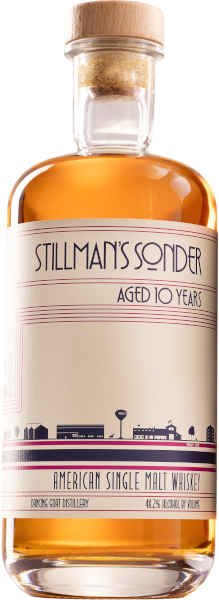
Stillman’s Sonder American Single Malt Whiskey Aged 10 Years

Stillman’s Sonder American Single Malt Whiskey Aged 10 Years

48.2% ABV
$70
Website
Stillmans Sonder American Single Malt Whiskey Aged 10 Years
We would like to thank Dancing Goat Distillery and Ro-Bro Marketing & PR for sending us a sample to review.

What the Producer Says

What began as a collection of orphaned barrels evolved into a project more than 10 years in the making. From 2010 to 2016, distillation at MGP in Indiana included a series of large exploratory test runs which resulted in a number of unused barrels. Recognizing their potential, the Maas family quietly acquired and curated these stocks over time, with a vision to release them as 10 plus year aged whiskey.

Led by Tom and Nick Maas, the Dancing Goat team embarked on an 18-month process of analysis, blending, finishing, and refinement to take the most choice barrels from their elusive aged stocks. Stillman’s Sonder American Single Malt was distilled in Indiana and aged in Wisconsin. After initial maturation, it underwent three rounds of blending, re-barreling, and finishing across a range of casks—including virgin oak, ex-bourbon, Wisconsin brandy, Cognac, and Calvados—before bottling at 96.4 proof (48.2% ABV).

“Stillman’s Sonder is both a tribute and a celebration of everything made possible by the spirit makers of America’s Heartland,” said Nick Brady Maas, Contemporary Stillman and Blender, Stillman’s Sonder.

What Gary Says

Nose: Fruit salad with peaches, pears and apricots, caramel, toffee, malted grain, and a hint of fresh walnuts.
Palate: Creamy mouthfeel, vanilla flan, pears, apples, oak, cinnamon, cloves, and a touch of cedar.
Finish: Moderately long with honey, caramel and cinnamon.
Comments: This is impressive. American Single Malt is a growing category, and bottles like this are a big part of the reason why. This is delicate, with the cedar note hinting slightly at juniper (not like you’d mistake this for a gin, but like there was a drop of gin in the mix). For me the newness of the category is what makes it interesting, as we don’t have some preconceived notion of “This is what American Single Malt should be” – it can surprise us. And most importantly – sipping it on the back porch was most enjoyable!

Rating: Must Try

Stillman’s Sonder American Single Malt Whiskey Aged 10 Years Read More »

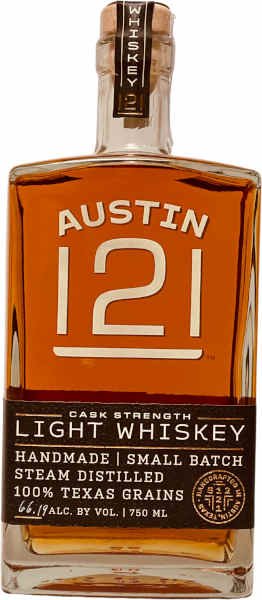
Austin 121 Cask Strength Light Whiskey

Austin 121 Cask Strength Light Whiskey

66.9% ABV
$94
Website
Austin 121 Cask Strength Light Whiskey
We would like to thank Austin Craft Spirits Company and The Whiskey Bard for sending us a sample to review.

What the Distillery Says

AUSTIN 121 CASK STRENGTH LIGHT WHISKEY
Welcome to the family! Austin 121 shares the same crafting principles as Austin 101 Light Whiskey, the most-awarded Light Whiskey ever. Austin 121 starts its life as a barrel of Austin 101. We sample and select a few exceptional barrels with unique character and excellent flavor. When the whiskey achieves perfection, after aging longer, it is bottled at full cask strength. Currently, Austin 121 is available as a single barrel program with select top retailers in Texas.

A Unique Light Whiskey Experience
Austin 121 Cask Strength Light Whiskey has a more intense nose with mineral, butterscotch, and vanilla aromas and is darker and spicier than Austin 101. It also exhibits unique barrel characteristics such as spiciness or buttery sweetness and a long, shockingly smooth finish. Each bottle has its barrel number and the specific cask strength, varying from 121 to 136 proof.

How can it be over 125 proof? Austin 101 enters the barrel at 125, but while aging, a small portion evaporates through the oak. This loss is called Angel’s Share. The extreme heat and dry hill country air can cause the “Angel’s” to take more water than alcohol. So, it is normal for the proof to vary and increase with age.

Precision Crafting
The whiskey is column distilled to a higher proof to create less byproducts and congeners while preserving the natural sweetness and taste of the original grain. It is delicious the moment it comes off the still, and only the finest hand-selected barrels qualify to hold it.

The Ultimate Light Whiskey Experience
Austin 121 has the intensity and purity of a wheated bourbon mash made from 100% Texas grains. Bottled right from the barrel, you will enjoy the ferocious, darker spice flavor of a unique light whiskey at full cask strength. This spirit is easiest to enjoy over one large, cold cube where it stands up well to a little ice.

What Gary Says

Nose: Vanilla, honey buttered bread roll, butterscotch, hint of fruit and oak.
Palate: Thich with a creamy mouthfeel, raw saw palmetto honey, cast iron corn bread, butterscotch, dark fruit notes with cinnamon and pepper spice.
Finish: Short in length with dark honey and pepper.
Comments: As we don’t see a lot of ‘light whiskey’, added a short excerpt below*. This returns to the same mashbill as the Austin 101 Light Whiskey (so moving from 101 to 111 to 121 – not a progression of the same spirit). Definitely get the familial relation to the 101, but this one has the volume turned up. Of the three Austin Light Whiskies, this one I could sip and enjoy – which is faint praise. For the money (nearly double the cost of the 101 at nearly a hundred dollars), I’d be pretty disappointed. The sample here also notes it is aged “at least 1 year”, and given the used casks I think they aren’t providing the spirit many option to develop flavor unfortunately.

Rating: Probably Pass/Average


*Light whiskey is an entirely different category, so important that when approaching it you’re not expecting it to be ‘bourbon’ or ‘rye’ or ‘corn’, because if you do – you’re likely to be disappointed. Where bourbon can’t come off the still any higher than 160 proof (80% ABV), light whiskey has to be higher than that (but less than 190 proof or 95% ABV, since then you’re classified as a grain neutral spirits). There are other legal requirements, but most light whiskey is used for blending into flavored products.

Austin 121 Cask Strength Light Whiskey Read More »

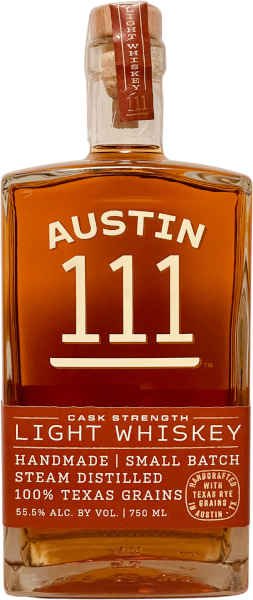
Austin 111 Cask Strength Light Whiskey

Austin 111 Cask Strength Light Whiskey

55.5% ABV
$63
Website
Austin 111 Cask Strength Light Whiskey
We would like to thank Austin Craft Spirits Company and The Whiskey Bard for sending us a sample to review.

What the Distillery Says

AUSTIN 111 CASK STRENGTH LIGHT WHISKEY MADE WITH RYE
Bold, award-winning, and crafted for the true Texas spirit.
Austin 111 is the latest expression from Austin Craft Spirits Company—crafted from a unique mashbill of 70% Texas rye and 30% non-GMO Texas white corn. Steam distilled to over 160 proof and aged for at least one year in recycled, award-winning Texas bourbon barrels, this whiskey undergoes a slow proof reduction with pure Hill Country water to achieve its signature 111 proof (55.5% ABV).

The result is a whiskey that’s darker and spicier than its predecessor, Austin 101, yet shockingly smooth. It delivers a perfect harmony of bold rye spice balanced with a subtle, brown-sugar sweetness from the barrels and a light, mellow oak finish.

Award-Winning Distinction

Recognized with a Gold Medal at the 2025 Denver International Spirits Competition, Austin 111 is the rye whiskey enthusiasts have been waiting for.

“Austin 111 is the rye whiskey our fans have been craving since we started this journey with Austin 101. We’ve spent years perfecting this—listening to the buzz at whiskey clubs and festivals—and the result is a cask-strength stunner that’s bold yet silky.”
– Tom Buchsbaum, Co-Founder

Austin 111 joins a family of renowned spirits—including Austin 101, the Double Platinum Best in Class winner; Austin 121, a cask-strength favorite; and Austin 85, our cocktail-ready light whiskey—each reflecting our commitment to 100% Texas grains, sustainable barrel practices, and precision distillation.

What Gary Says

Nose: Toasted oak, rye toast with grilled corn and a hint of caramel.
Palate: Creamy mouthfeel, honey, brown sugar, vanilla, cinnamon and pepper spice.
Finish: Short in length with a hint of caramel and pepper spice.
Comments: As we don’t see a lot of ‘light whiskey’, added a short excerpt below*. Unlike Austin 101 Light Whiskey, this doesn’t remind me much of corn whiskey, and does have an entirely different mashbill. This is also an older product, with the bottle noting it is aged “at least 1 year”. Noticeably darker in the glass, and I get a note of rye on the nose. I think there’s potential in light whiskey (as noted before, I’ve had some I really liked), but this was similar to the Austin 101 Light Whiskey in terms of not being in my wheelhouse.

Rating: Probably Pass


*Light whiskey is an entirely different category, so important that when approaching it you’re not expecting it to be ‘bourbon’ or ‘rye’ or ‘corn’, because if you do – you’re likely to be disappointed. Where bourbon can’t come off the still any higher than 160 proof (80% ABV), light whiskey has to be higher than that (but less than 190 proof or 95% ABV, since then you’re classified as a grain neutral spirits). There are other legal requirements, but most light whiskey is used for blending into flavored products.

Austin 111 Cask Strength Light Whiskey Read More »